
Stop describing your product. Start describing your user.
The 3-Line Sales Page

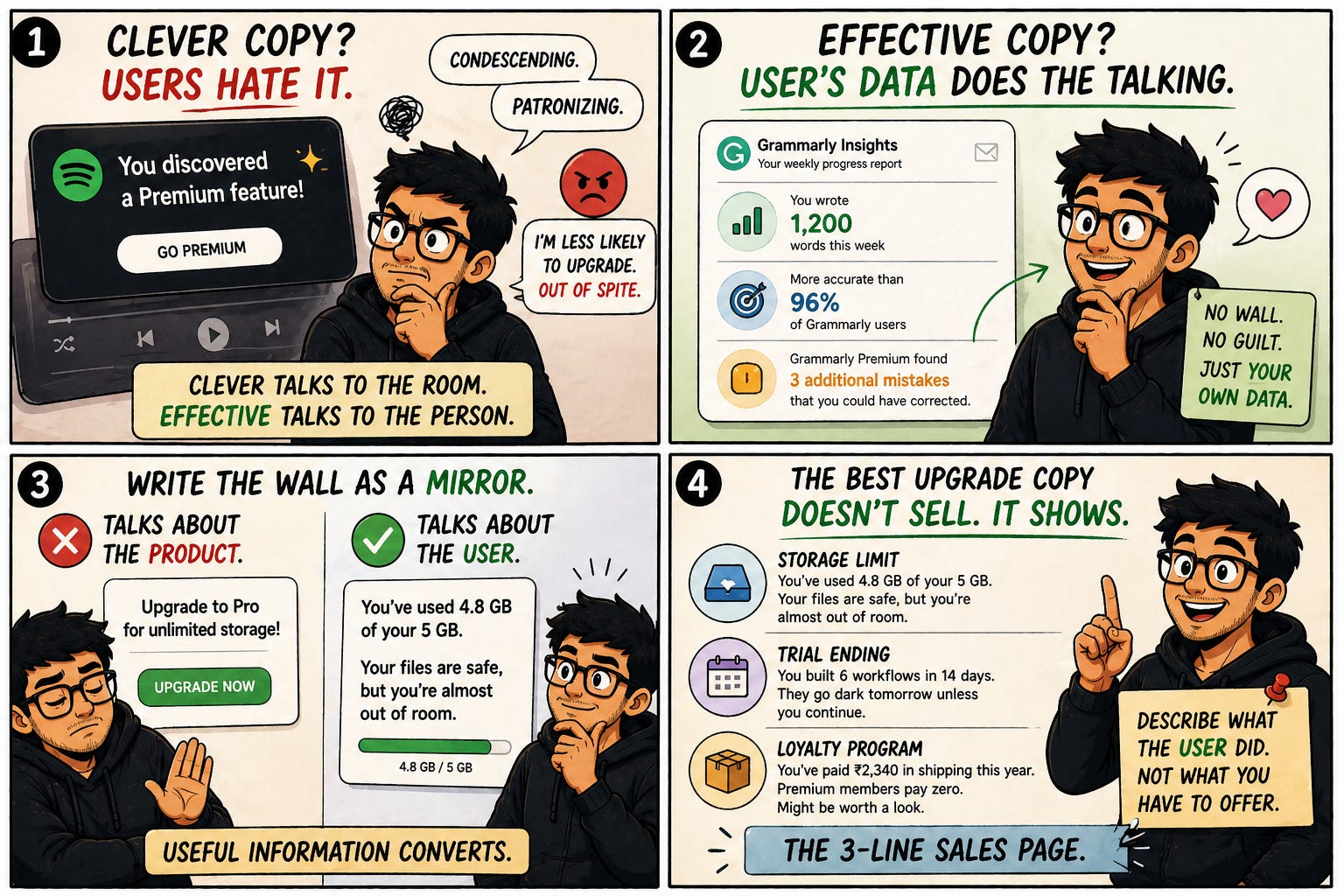
Spotify has over 600 million users on its free plan.
To convert them, they built a small message that appears when free users try to skip songs or turn off shuffle.
The copy says:
“You discovered a Premium feature!”
The idea was to reframe a restriction as a discovery. Make the paywall feel like an invitation.
Users hated it.
Spotify’s community forums are full of people calling it condescending. Patronizing. One user wrote that it made them less likely to upgrade, out of spite.
The copy tried to be clever. But clever and effective are not the same thing. Clever talks to the room. Effective talks to the person sitting in front of you.
(Source: Spotify Community forums, multiple threads, 2023–2025)
Now look at Grammarly.
Every Monday, Grammarly sends free users a personalized email called Grammarly Insights. It tells you how many words you wrote that week, your accuracy score, and how you compare to other users.
The email feels like a progress report. You see something like “You were more accurate than 96% of Grammarly users this week” and feel a small hit of pride.
Then, below the stats, one quiet line:
“Grammarly Premium found 3 additional mistakes that you could have corrected.”
No wall. No guilt trip. Just your own data, showing you what you missed.
It works because the pitch is built from something the reader already trusts: their own writing habits. The email gives you a win, then gently reveals the gap between where you are and where you could be.
(Sources: Grammarly Blog, Email Mastery teardown, RAMMP case study)
The part nobody talks about
These two examples show something about a type of copy that barely gets any attention.
The message when someone hits a paywall. The email nudging a free user to upgrade. These tiny moments are sales pages. Compressed into a few lines. No hero image. No testimonial carousel. Just a moment and a click.
Most companies hand this copy to a product manager or leave it as default placeholder text. Then they wonder why their free-to-paid conversion rate sits at 2%.
The trick: write the wall as a mirror
Spotify wrote a wall disguised as a door. Users saw right through it.
Grammarly wrote a mirror. It reflected the user’s own behaviour back at them, and let the gap between free and paid speak for itself.
When you’re writing copy for an upgrade moment, ask yourself one question: am I talking about my product, or am I talking about my user?
Copy about your product (”Unlock premium features!”) sounds like an ad.
Copy about the user (”You’ve used 14 of 15 projects this month”) sounds like useful information. And useful information converts.
Try these
SaaS, storage limit:
Instead of:
Upgrade to Pro for unlimited storage!
Write:
You’ve used 4.8 GB of your 5 GB. Your files are safe, but you’re almost out of room.
SaaS, trial expiring:
Instead of:
Your trial ends tomorrow. Subscribe now!
Write:
You built 6 workflows in 14 days. They go dark tomorrow unless you continue.
E-commerce, loyalty program:
Instead of:
Join our Premium membership for free shipping and exclusive deals!
Write:
You’ve paid ₹2,340 in shipping this year. Premium members pay zero. Might be worth a look.
Your turn
Open your product right now. Find the exact moment where a free user hits a wall or a limit.
Read the copy that appears there.
Now rewrite it. But instead of describing your product, describe what the user just did. Use their data. Use their behaviour. Make it feel like a fact about them, not a pitch from you.
The best upgrade copy doesn’t sell. It shows.
The 3-line sales page.
Goal of the newsletter: Sharing simple, practical, yet highly effective copywriting techniques Audience: Marketers, Copywriters